

Have you ever wondered what’s happening in the stock portfolios of public officials? In a world driven by data, a new AI tool is about to pull back the curtain on the financial dealings of Indian politicians, expanding a powerful feature already active in the United States.
Perplexity AI, the popular AI-powered answer engine, is gearing up to launch this groundbreaking feature on its Perplexity Finance platform. The new tool will allow anyone in India to view and track the stock market investments of their politicians.
This isn’t just a rumor. The news was confirmed directly by the company’s CEO, Aravind Srinivas. In a public exchange on X (formerly Twitter), a user asked how they could track investments made by Indian politicians. Srinivas’s simple reply sparked a massive online discussion: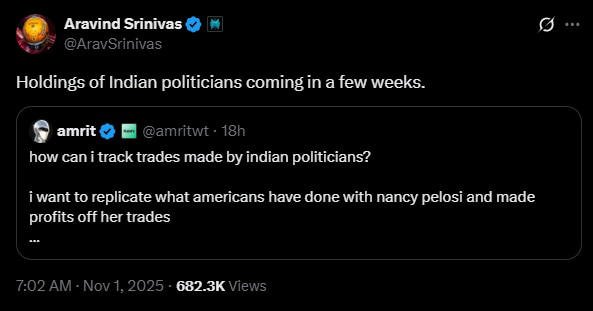
“Holdings of Indian politicians coming in a few weeks.”
This move signals a significant step toward financial transparency, leveraging AI to make complex public data accessible to everyone.
How Will This Even Work? (It’s Already Working in the US)
This isn’t a brand-new experiment. Perplexity is bringing a feature to India that is already fully implemented and popular in the United States. The company isn’t starting from scratch; it’s localizing a proven tool.
In the US, Perplexity Finance already allows users to:
- Search by Politician: You can look up a specific politician (like Nancy Pelosi, who is famous for her stock trades) and see their entire reported portfolio and recent trades.
- Search by Company: You can look up a company (like Apple or Amazon) and see which politicians hold its stock.
For the Indian version, Perplexity AI is expected to use the same playbook. It will gather and organize information from various public-service documents, including:
- Election Affidavits: Documents that politicians must file with the Election Commission of India (ECI) when they run for office, detailing their assets and liabilities.
- Annual Asset Declarations: Filings required under laws like the Lokpal and Lokayuktas Act.
- Other Financial Disclosures: Any other financial data mandated by Indian regulatory bodies.
The goal isn’t to uncover secret data; it’s to make legally public data searchable, simple, and clear for the average person.
Why This Is a Big Deal for India
The excitement online is understandable. Supporters of the move see it as a powerful tool for public accountability.
In theory, this feature could help voters, journalists, and watchdog groups easily identify potential conflicts of interest. For example, if a politician is involved in making policy for a specific industry (like technology or pharmaceuticals), voters might want to know if that same politician is heavily invested in companies within that industry.
Perplexity’s move is part of a larger, deliberate focus on the Indian market. The company has already integrated live BSE/NSE market data, showing a deep commitment to Indian users. This new transparency tool, making India the second major democracy to receive this feature, is the next logical—and bold—step.
The Big Question: Will It Really Work in India?
While many are excited, a significant wave of skepticism has also surfaced online. This is where the “not-so-controversial” but “practical” challenges come in.
Users familiar with the Indian context quickly pointed out a major hurdle that is different from the US market: assets are often not held in the politician’s own name.
Many comments on X highlighted that it’s a common practice for assets to be held in the names of relatives, spouses, or in complex benami (unnamed) accounts. One user noted, “Indian politicians typically don’t invest using their own name,” while another observed, “Mostly, they hold their assets on relatives or benami names.”
This is a real challenge that an AI tool might struggle with. If the public data only shows what’s directly under a politician’s name, the tool might only present a tiny, incomplete picture of their actual wealth and investments.
A “Make or Break” Move?
The online discussion has been a mix of high praise and serious caution. Some commenters warned Aravind Srinivas that this is a “make or break” move for Perplexity in the Indian market.
There are concerns about potential regulatory backlash. Some users feared that powerful figures might not appreciate this level of scrutiny, leading to pressure that could get the product “banned” or caught in “dirty waters with the Babus” (a colloquial term for bureaucrats).
Despite these worries, the overwhelming sentiment from supporters is that this feature is necessary and a welcome step toward accountability. As one user put it, “Excited to see real financial disclosures soon.”
For now, Perplexity AI is pushing forward, armed with the experience from its US launch. If it can navigate India’s unique challenges, it could set a new global standard for how AI can empower citizens and drive transparency in public life.